October in Prosper can still feel like summer, but the first cold front is never far off — and the habits you set now decide how easily your pool gets through winter. For many Prosper families — especially the ones who added a pool in the last year or two — this is the first time they've had to think about what a pool needs once the weather turns.
Prepping for fall and winter isn't complicated, but it is different from summer care. As the season turns, wind and leaves put more debris in the water, cooler temperatures change how your chemistry behaves, and freezes can arrive with little warning. Whether you live in Windsong Ranch, Star Trail, Whitley Place, Prairie View, or anywhere else in Prosper, the same few habits will carry your pool safely to spring.
Why Fall Matters for Prosper Pools
Leaves, wind, and debris
Fall cold fronts bring wind, and wind brings debris. In established neighborhoods with mature trees — Gentle Creek is one of the most established in town — leaves can blanket a pool in a single gusty afternoon. Newer communities have younger landscaping, but open lots let the wind carry in dust, clippings, and leaves from down the street.
Debris isn't just cosmetic. Leaves that sink to the floor break down, feed algae, use up your sanitizer, and can stain plaster and pebble finishes. They also pack skimmer and pump baskets, quietly cutting circulation right when you need it most.
Cooler water changes your chemistry
As the water cools, algae growth, chlorine use, and evaporation all slow down. That helps — but it isn't a reason to stop testing. Water that sits unbalanced all winter is harder to bring back in spring.
- Sanitizer still matters. Algae slows in cool water but doesn't stop, and a warm stretch in November can give it an opening.
- Salt systems may slow down. Many salt chlorine generators reduce or pause output in cold water. Check your settings so chlorine doesn't quietly drop to zero.
- Keep pH and alkalinity in range. The summer targets still apply — pH around 7.4–7.6 and total alkalinity around 80–120 ppm — to protect your plaster, tile, and equipment.
Your October–November Pool Checklist
Keep debris out
- Skim often — daily during heavy leaf drop, if you can.
- Empty the skimmer and pump baskets more often than in summer. A packed basket starves the pump.
- Brush and vacuum leaves off the floor before they settle in.
- Trim back branches that hang over the water.
Rebalance for cooler water
Test weekly and adjust in the usual order: alkalinity, then pH, then sanitizer. Let the water circulate before you retest. If you plan to winterize, this is the balance you want locked in before the pool is closed.
Adjust pump runtime — and check freeze protection
As the water cools, many pools can run fewer filtration hours than they did in July. Just keep runtimes long enough to handle leaf season, and never let a schedule change touch your freeze protection. If your equipment has a freeze guard or a freeze-protection setting in its automation, confirm it's enabled and working now. Freeze guards turn the pump on when temperatures drop — but they only work when the power is on.
Inspect equipment before the cold
Fall is the best time to find a problem: the pool is in lighter use, and nothing is frozen yet. Walk the equipment pad and look for:
- Drips or leaks at the pump, filter, heater, and valves
- A pump that's louder than it used to be, or one that loses prime
- Filter pressure running higher than normal
- A heater that's slow to ignite — you'll want it if you heat the spa this winter
- Cracked or brittle fittings and plumbing
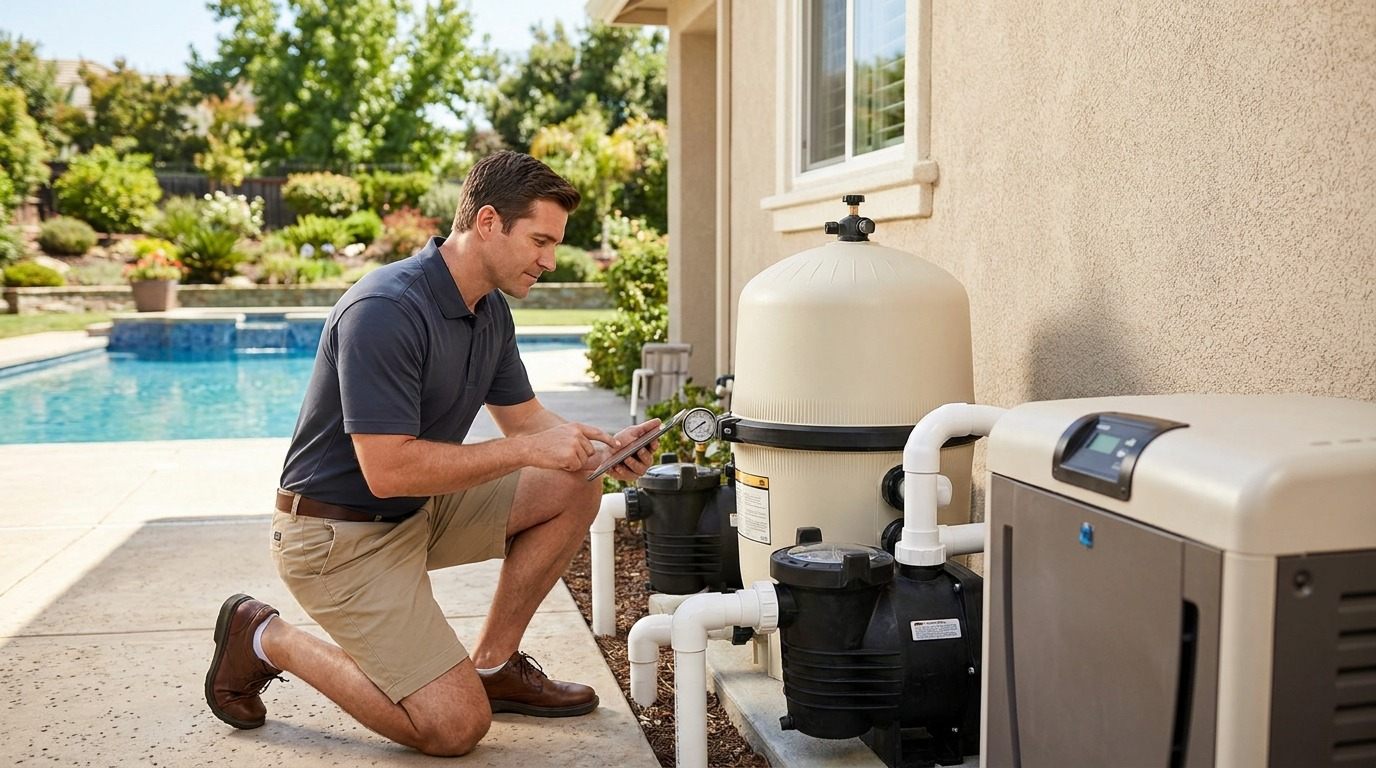
A small leak is a simple fix in October. In a hard freeze, it can become cracked plumbing. If something looks off, our pool equipment repair team can take a look before the weather turns.
Winterize or Keep It Running?
This is the big decision for North Texas pool owners, and both approaches can work. What matters is choosing one on purpose instead of drifting into winter with no plan.
Option 1: Full winterization
Winterizing gets water out of the places where it could freeze and crack things. The water is balanced and treated, the level is lowered below the skimmer and returns, the plumbing lines are blown out, the equipment is drained and protected, and the cover goes on.
Early freezes can happen as early as November in North Texas, so we recommend winterizing in late November — before the first hard freeze, not after it. See the full process on our pool winterization page.
Option 2: Running through the winter
Some Prosper homeowners keep the pool open all winter, especially if they enjoy a heated spa on cold evenings. That can work, as long as the pump runs continuously during freezes — moving water doesn't freeze in the lines the way standing water does.
The weak point is power. If the electricity goes out during a hard freeze, the pump stops and the freeze guard can't do its job. That's what happened across DFW during the February 2021 winter storm, when widespread power outages left many pools sitting still through days of freezing weather. If you run your pool through the winter, decide ahead of time what you'll do if the power drops.
When a hard freeze is in the forecast
- Running pools: confirm the pump is on and freeze protection is active. Don't shut the system off to protect it — the circulation is what's protecting it.
- Winterized pools: make sure the cover is secure and the equipment hasn't been switched back on.
- After a power outage: once power returns, check that the pump restarts and water is moving, then look over the equipment pad for cracked fittings or new leaks.
Signs Something's Wrong Going Into Winter
Fall is a good time to notice what the summer heat was hiding:
- Water loss that seems like more than evaporation. Evaporation slows as temperatures drop, so a water level that keeps falling through the fall is a red flag. Our leak detection service can pinpoint where it's going.
- Equipment that's noisy, leaking, or cycling on and off.
- Cloudy or green water that won't clear even when the chemistry looks right.
Any of these is easier to handle now than in January.
Spring Starts in the Fall
A pool that stays clean, balanced, and protected all winter opens easily. Most North Texas pool owners reopen between mid-March and mid-April, once overnight temperatures consistently stay above 50°F. When the time comes, our spring pool opening service can handle it — or follow our guide to prepping your pool for summer.
Why Prosper Pool Owners Choose Prestige for Service
Our showroom on Preston Road in Frisco is about 5 miles from most Prosper neighborhoods, and our service team works with homeowners across all of Prosper's communities.
- We build pools, so we know the systems. When we've built your pool, we already know every part of it.
- In-house technicians. Our service team members are Prestige employees, not subcontractors — trained, insured, and accountable.
- Certified professionals. We have CPO-certified professionals on staff, credentialed through the Pool & Hot Tub Alliance.
- Equipment know-how. Our technicians are trained on Pentair, Hayward, Jandy, Raypak, Zodiac, and other major brands, and our trucks carry common parts, so many repairs can be handled in a single visit.
- Priority response for service customers — typically same-day or next-business-day for equipment failures.
- A long local track record. More than 20 years in business, the largest pool showroom in DFW, and hundreds of Google reviews from pool owners across the area.
Learn more about pool service in Prosper, or see everything our service and maintenance team handles. For fall cleanup, winterizing, or a pre-winter equipment check, reach out to our team or call (469) 644-7665 — or stop by our showroom, just down Preston Road.